Play · Growth · Human Flourishing·Powered by AI
Moses Silbiger, MA
Researcher - AI · Interactive Entertainment · Developmental Psychology

Developmental Psychology

The MAP

Developmental Psychology
Evolution: 2008-2026 (current 'Zeitgeist')
Where the field is today, and what it contributes to the Press Play to Grow! convergence

What's Inside


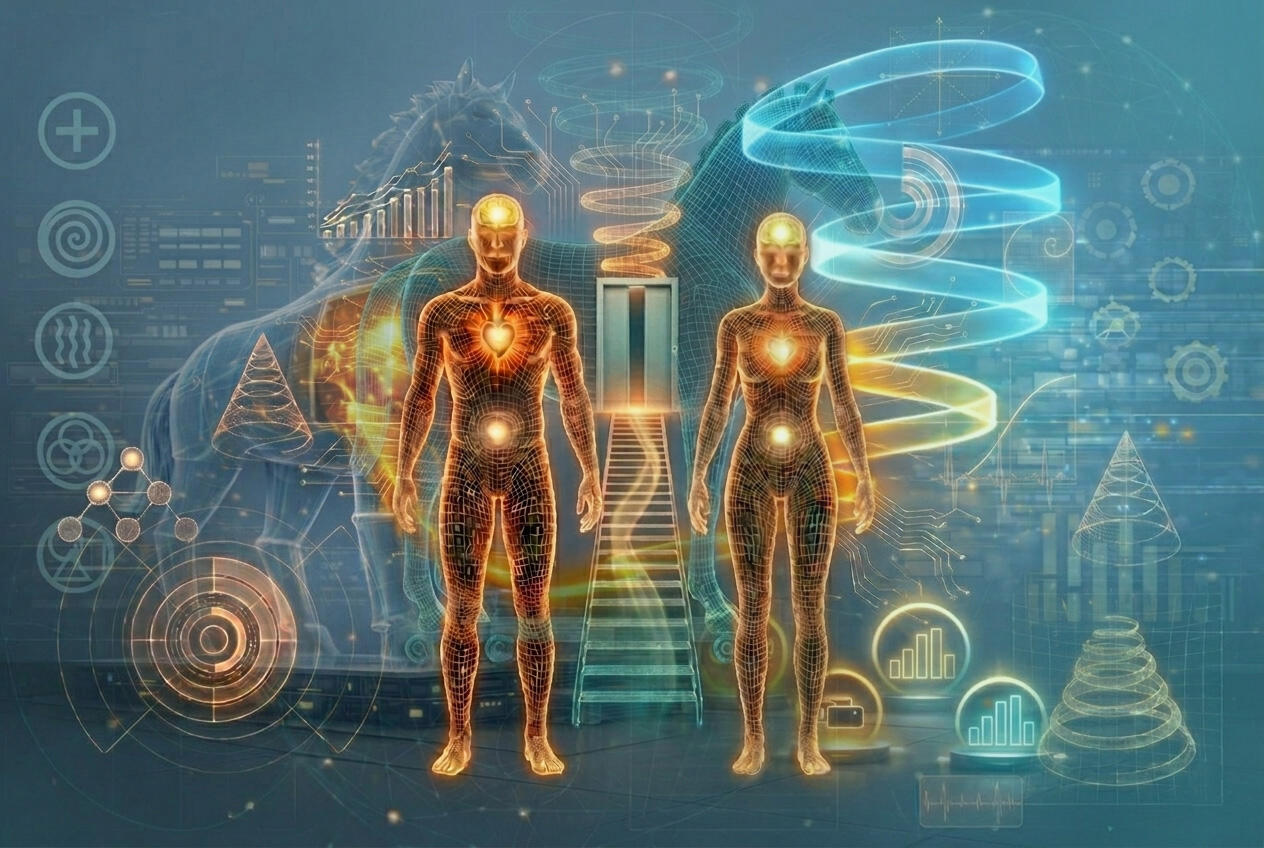
The Map That Changes Everything
Without a compass for human growth, the engine has nowhere to go

"The bridge from knowing to doing — from understanding development to actually supporting it - is the most important bridge we haven't yet built."
- Robert Kegan, Harvard University

"There are three general types of developmental lines. One relates to cognition itself - the cognitive line.
Then there's the self-related lines - where a person's center of gravity is, their actual core identity.
If the cognitive line is sort of a person's talk, the self-related lines are their walk. And then the third type are investigated
mostly by Howard Gardner - I call them talents or gifts. Multiple intelligences - kinesthetic, musical, mathematical capacity."
- Ken Wilber, interview with Moses Silbiger, Integral Life, 2008

""The most challenging would be the self-related lines, because those involve in a sense a kind of death and rebirth."
- Ken Wilber, personal communication, February 2008 - cited in Silbiger, M., JITP, Vol. 5, No. 2, 2010

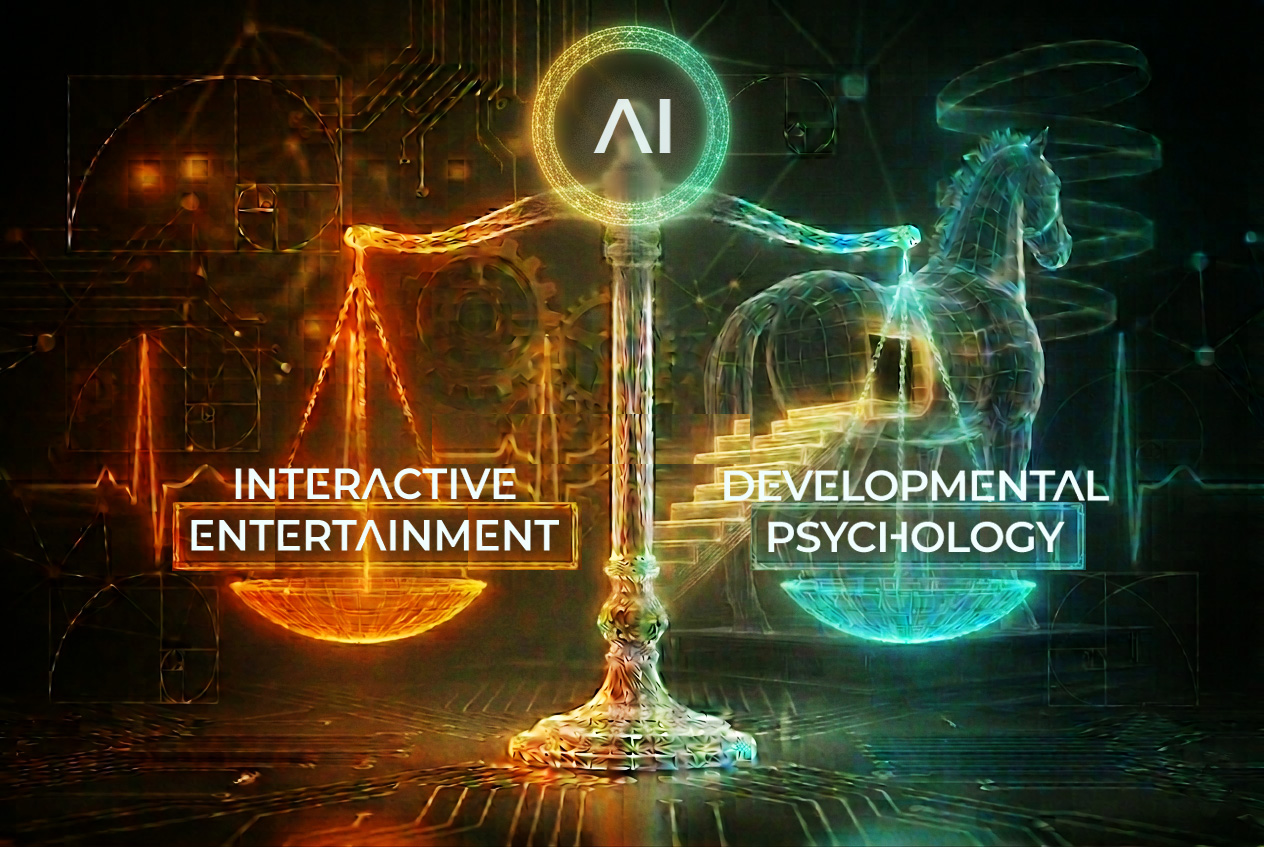
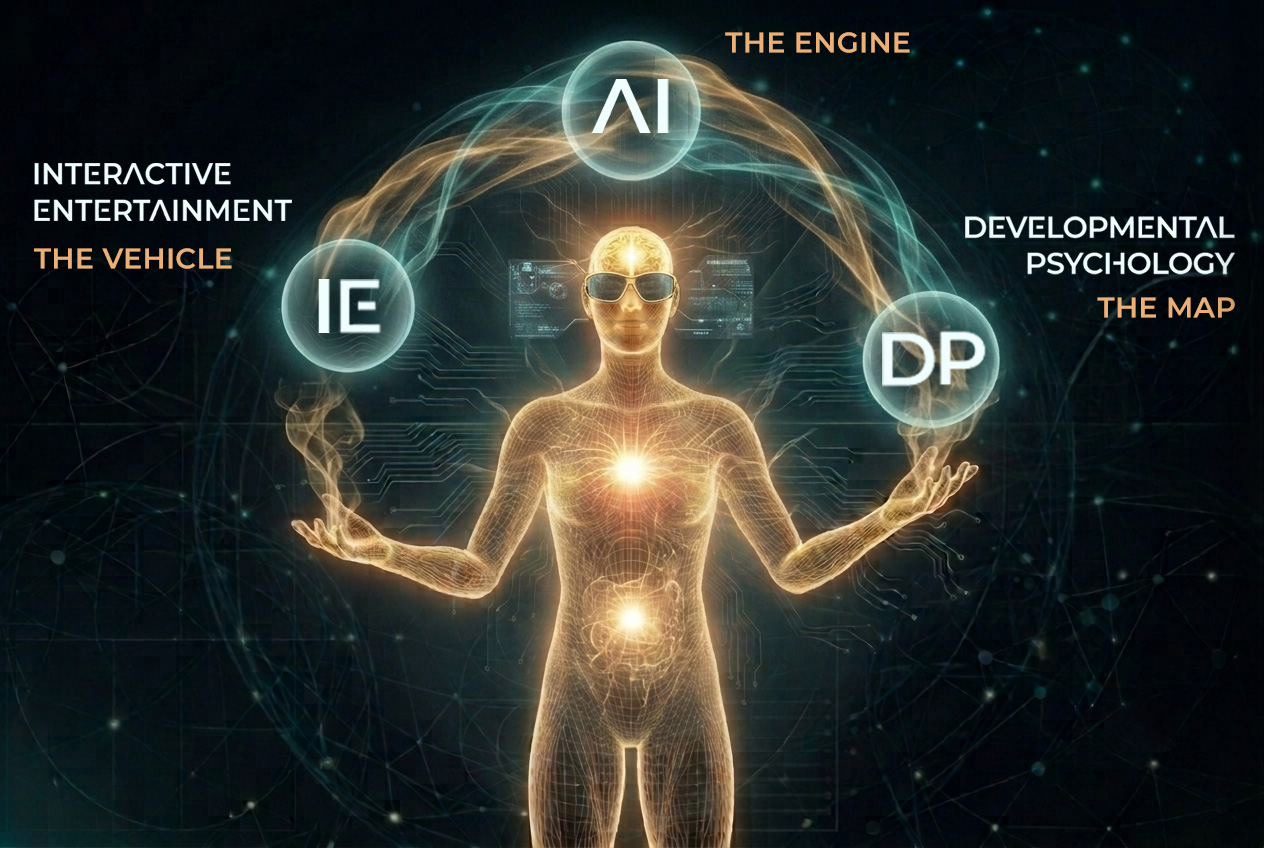
Of the three pillars of Press Play to Grow!, developmental psychology is the one that provides the map, the compass.
Interactive entertainment is the vehicle. AI is the engine.
But without a sophisticated understanding of how human beings actually grow - what development looks like, how it unfolds, what dimensions
it moves through, and what conditions support it - the vehicle goes nowhere meaningful and the engine runs without direction.
This is the pillar that most of the world of interactive entertainment and AI doesn't have. And it is the pillar that makes Press Play to Grow!
something qualitatively different from anything else being built at this convergence.

A Significant Shift
From Stages as Labels to Stages as Living Terrain
In 2008, developmental stages were often talked about as if they were boxes - discrete categories that described where a person was.The research community understood that this was a simplification, but the simplification dominated both how the frameworks were taught
and how they were applied.
What has emerged more clearly since then is a richer picture: stages as terrain, not boxes. Development is not a staircase where you step
from one platform to the next. It is more like a landscape that you move through - and the landscape includes regression, oscillation, context-dependence,
and the simultaneous presence of multiple stage capacities in the same person depending on the domain, the stress level, the relationship, and the moment.
This matters enormously for Press Play to Grow! An experience designed to support developmental growth cannot treat the player as fixed at a single stage.It has to be responsive to the actual, dynamic, contextual nature of how development moves - sometimes forward, sometimes backward,
always more complex than any simple label captures.
This is precisely where AI's capacity for real-time sensing and adaptation becomes not just useful, but essential.
New empirical work strengthens this terrain view.A November 2025 study analyzing personal diaries spanning up to 25 years found adult development to be many simultaneous, domain-specific trajectories,
and that adults grow not only by adapting inwardly but by actively reshaping their material and symbolic environments, a reminder that developmental data increasingly lives in the traces people leave, precisely what AI systems are built to read.


Lines of Intelligence
The Most Directly Relevant Framework
Within the AQAL model of Integral Theory - the comprehensive developmental framework that Press Play to Grow! draws on -
one of the five core elements is what Ken Wilber calls Lines of Development. This is the insight that human beings do not develop as a single unified whole.We develop along multiple distinct lines - cognitive, emotional, moral, interpersonal, kinesthetic, aesthetic, spiritual, and others - each of which
has its own developmental sequence and can be at a different level of maturity in the same person at the same time.
The parallel in mainstream developmental psychology is Howard Gardner's theory of Multiple Intelligences, developed at Harvard. Gardner proposed
in 1983 that intelligence is not a single capacity but a family of distinct abilities - linguistic, logical-mathematical, spatial, musical, bodily-kinesthetic,
interpersonal, intrapersonal, naturalistic, and potentially others. Each develops at its own rate, in its own way, through different kinds of experience.
In 2025, Gardner himself published an update drawing on new neuroscience research. What researchers are now finding is that distinct brain networks
correspond to each of the intelligences he proposed - the visual network for spatial intelligence, somatomotor networks for kinesthetic intelligence,
the default mode network for intra- and interpersonal intelligence, and so on. As Gardner noted: neural systems can "acquire different software
as a function of experience" - cognitive flexibility and specialization coexist.The neuroscience is catching up to what the theory proposed four decades ago.
For Press Play to Grow!, lines of intelligence are the most practically powerful element of the entire developmental framework.They answer a specific design question that no other framework addresses as directly: if I want to create an experience that develops a specific
human capacity - say, empathy, or ethical reasoning, or bodily awareness:What does development in that line actually look like?
What experiences support it?
What challenges stretch it?
What does a more developed expression of it look like compared to a less developed one?
These are the questions that allow an intelligently designed interactive experience to go beyond general engagement and target specific
developmental growth - invisibly, inside an experience that feels like play.

Developmental Stages
The Ongoing Debate and What It Means for Press Play to Grow!
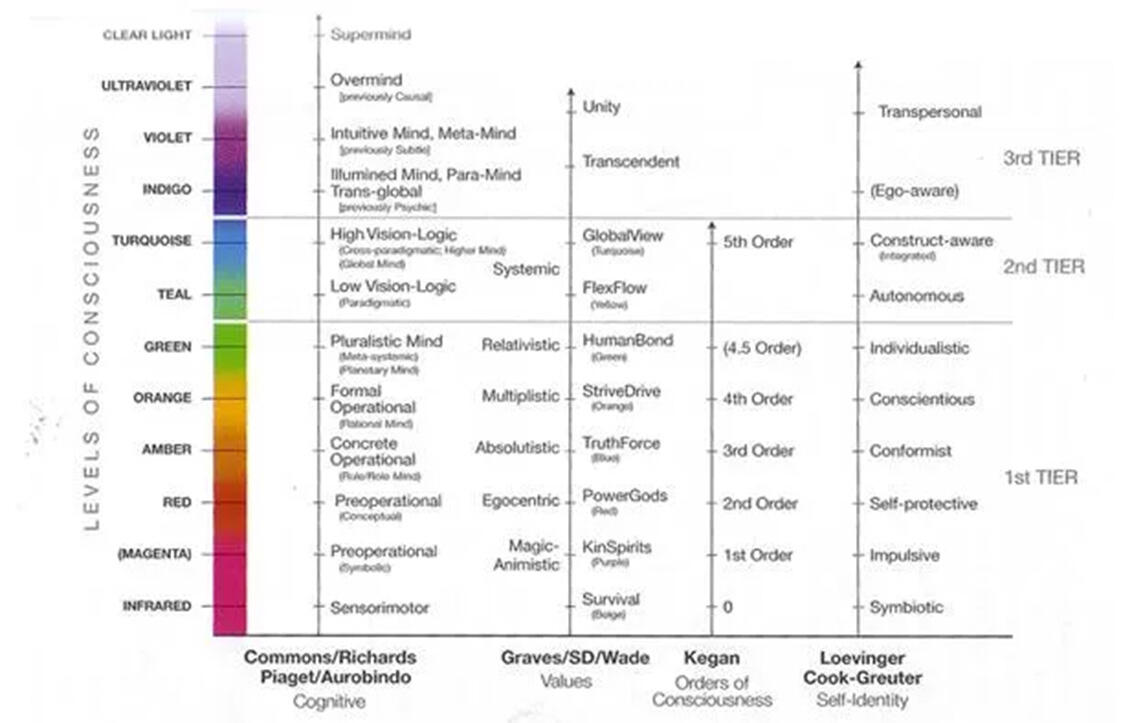
The other element of the Integral framework most directly relevant to PPG is Stages - the sequence of qualitatively different ways of making meaning
that developmental research has documented across multiple research traditions.
The foundational work here comes from Loevinger, expanded and refined by Cook-Greuter into what she calls a full-spectrum theory of ego development,
with nine levels ranging from the most concrete and egocentric to the most complex and integrated. Torbert's parallel framework maps these onto
leadership action logics.Kegan's orders of consciousness describe the same territory from a cognitive constructivist perspective.And the STAGES model, developed more recently, proposes a new structural explanation for how these levels relate to each other across three underlying dimensions.
What they all agree on, and what the research consistently supports, is that most adults in Western societies cluster in the middle range of these sequences -
what Cook-Greuter calls the conventional and early postconventional stages. The later stages, which involve increasing complexity, systemic thinking,
perspective-taking capacity, and ultimately ego-transcendence, are represented in very small percentages of the population.
The debate is not about whether development happens. It is about how to characterize it, how to measure it, whether stage sequences are universal
or culturally specific, and what conditions support movement from one level to the next.These are live questions in the research community, and Press Play to Grow! does not pretend to resolve them.What Press Play to Grow! proposes is that well-designed interactive experiences - grounded in whatever developmental frameworks prove most robust -
can be powerful conditions for supporting that movement.

The Five Elements of the Integral Framework
And What Each Contributes to Press Play to Grow!
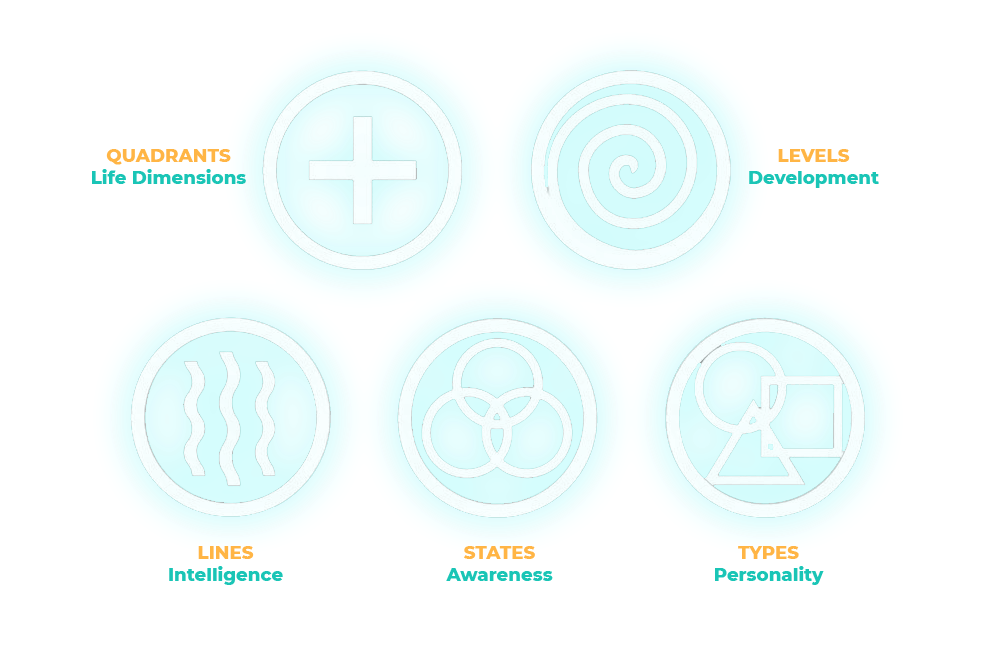
The AQAL model organizes human experience across five dimensions. Each one contributes something specific to how PPG thinks about designing for growth.
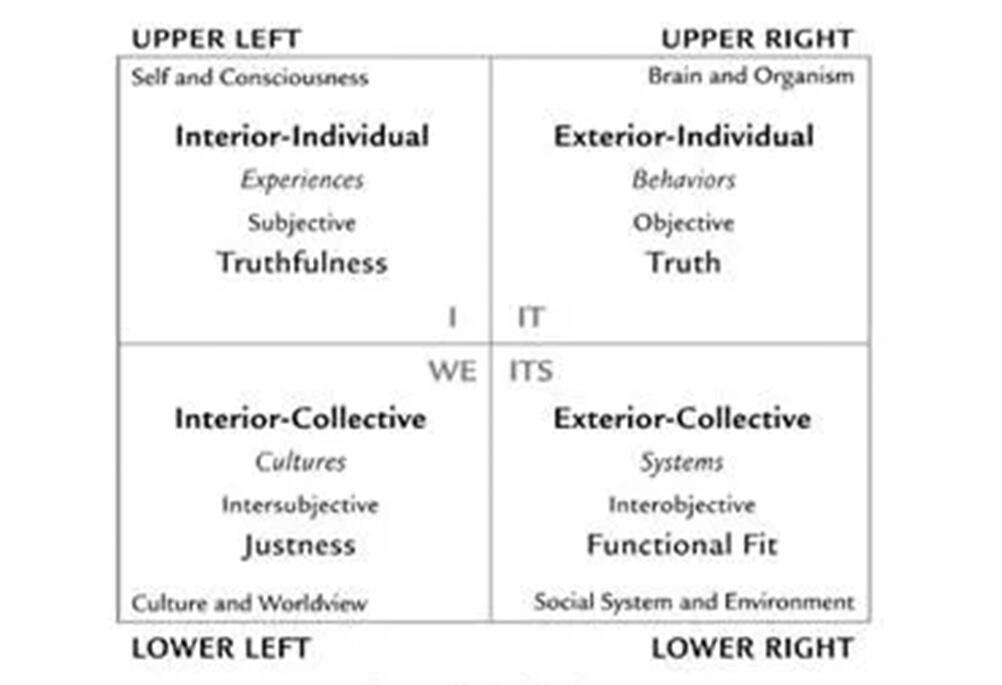
Quadrants - The Four Interconnected Life Dimensions of Existence & Experience
Quadrants map four irreducible dimensions of human existence:• Interior individual - Thoughts, feelings, subjective experience
• Exterior individual -Behavior, physiology, observable action
• Interior collective -Culture, shared meaning, relational dynamics
• Exterior collective -Social systems, institutions, technology, environmentDevelopment happens in all four simultaneously - and a genuinely comprehensive developmental framework has to address all four. This is what PPG means by catalyzing growth in cognitive, emotional, behavioral, ethical, kinesthetic, and experiential dimensions at once.
Quadrants map four irreducible dimensions of human existence:• Interior individual - Thoughts, feelings, subjective experience
• Exterior individual -Behavior, physiology, observable action
• Interior collective -Culture, shared meaning, relational dynamics
• Exterior collective -Social systems, institutions, technology, environmentDevelopment happens in all four simultaneously - and a genuinely comprehensive developmental framework has to address all four. This is what PPG means by catalyzing growth in cognitive, emotional, behavioral, ethical, kinesthetic, and experiential dimensions at once.
Levels / Stages - Progressive Steps Towards Further Development & Maturity
Levels / Stages are the sequential development of overall meaning-making complexity - how a person's entire worldview evolves from more concrete and self-centered to more complex, integrated, and expansive. Interactive experiences can be designed to gently challenge and expand a player's current stage without forcing or bypassing it - offering the kind of complexity that is just beyond their current center of gravity, in a way that feels engaging rather than threatening.
Lines - Multiple Lines of Intelligence

Lines are the multiple intelligences - the distinct developmental sequences for different human capacities.This is the element most directly useful for Press Play to Grow!'s design question: which line, in which direction, through what kind of experience?
States - States of Consciousness or Awareness

States are temporary altered conditions of consciousness - flow, peak experience, meditative absorption, creative immersion, emotional intensity. States matter enormously for Press Play to Grow! because interactive entertainment is one of the most reliable state-inducers available in everyday life.Flow - the state of effortless absorption in a well-matched challenge, first described by Mihaly Csikszentmihalyi - is produced naturally by well-designed games. And flow states are among the most powerful conditions for learning, growth, and positive development that research has identified. AI can help read and sustain these states in real time - adjusting the experience to keep the player in flow rather than tipping into frustration or boredom.
Flow itself gained new neuroscientific grounding in 2025.
Research found that flow is driven by learning progress: as a person perceives themselves improving, task engagement and cognitive control strengthen
in a loop visible in brain activity, a mechanism tied by parallel research to activities ranging from video games to musical improvisation.
Types - Types or Typologies of Personality
Types refer to stable personality orientations that cut across all stages and lines - ways of perceiving, interpreting, and engaging with the world that tend to be consistent across a person's life. Typologies like Myers-Briggs, the Enneagram, and others describe these. For Press Play to Grow!, types inform the texture
of how an experience is personalized. AI doesn't only read real-time states - it can also build a model of a player's type-based tendencies over time,
and adjust not just difficulty and pacing, but the very nature of the challenge, to match how a particular type engages most productively with growth.
Together, these five elements give PPG a map of human development that is more comprehensive than any single mainstream framework alone. They do not require that a player know anything about developmental psychology. They operate invisibly, in the background - informing design decisions, guiding AI adaptation, shaping the architecture of the experience. The player just plays.

Integral Life Practice - Where the Five Elements Converge
From developmental map to lived experience

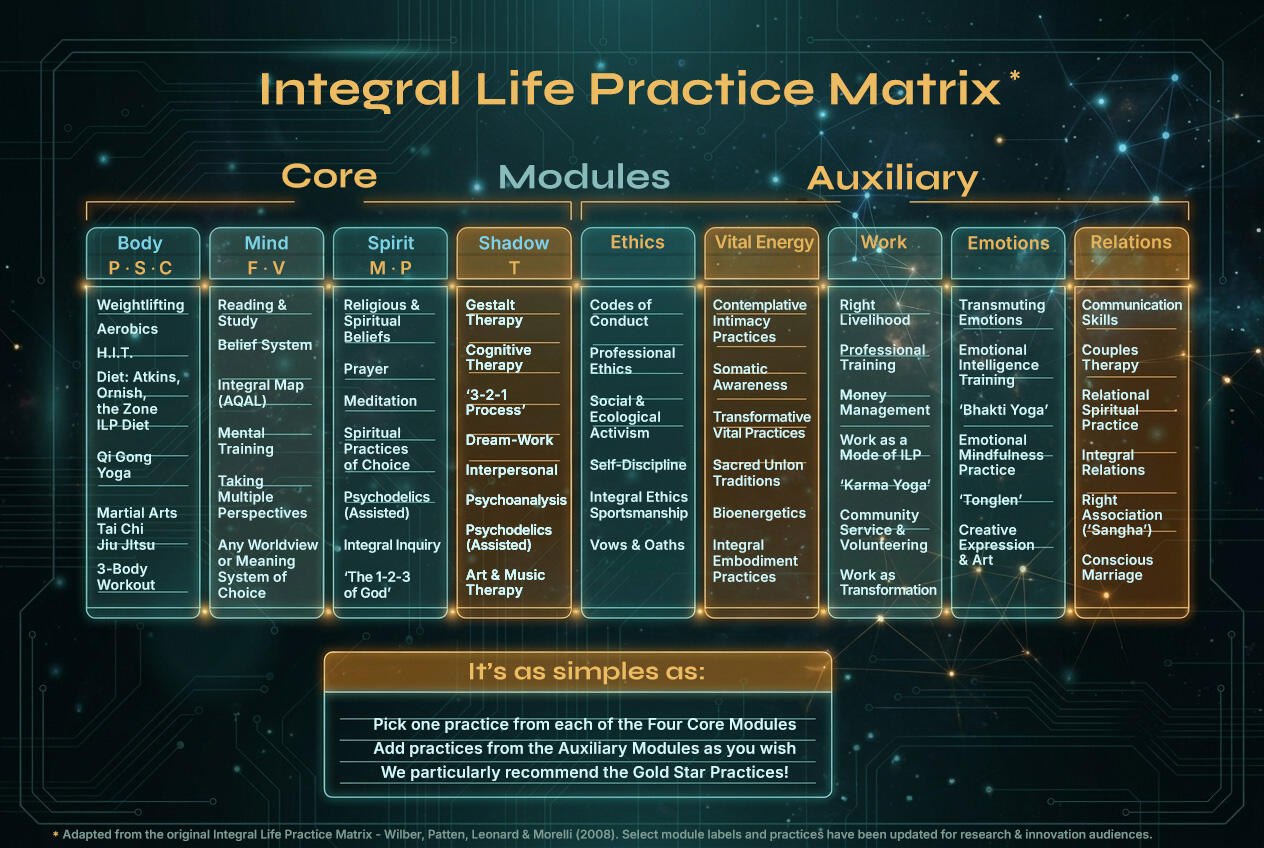
The Integral Life Practice Matrix*
Modules Core·Auxiliary
*Adapted from the original Integral Life Practice Matrix (2008)
Select module labels & practices have been updated for research & innovation audiences


The practical framework built on top of AQAL for doing exactly that is Integral Life Practice - a system of personal and spiritual evolution combining the most effective practices from ancient spiritual traditions with principles discovered and validated by modern science.
It is organized around four core modules - Body, Mind, Spirit, and Shadow - and five auxiliary modules - Eros, Ethics, Work, Emotions, and Relations.
The book and framework were co-created by Ken Wilber, Terry Patten, Adam Leonard, and Marco Morelli (Integral Institute), published in 2008.
The core insight of ILP is that purposeful engagement across multiple lines of intelligence creates a multiplier effect - growth in one line begins to push development in the others. This is the mechanism that Press Play to Grow! proposes to embed invisibly inside interactive experiences: not a single-line training program, but a cross-dimensional developmental architecture - powered by AI, delivered through play.

Integral Play - The Developmental Dimension of Play
How Play Drives Human Growth
A framework directly applied in the original Press Play to Grow! research is Integral Play - developed by Gwen Gordon and co-authored with Sean Esbjörn-Hargens, published in the Journal of Integral Theory and Practice in 2007. The framework explores the transformative potential of adult play through a developmental model that outlines the unfolding complexity of play in light of the evolution of consciousness - correlating specific play forms with developmental stages and showing how forms of play can both instigate and support transitions between stages. Gordon proposed eight Play Selves - each corresponding to a stage of ego development drawn from Cook-Greuter and Torbert's research - offering a map of how the quality and meaning of play transforms as consciousness evolves.
Since 2008, Gordon has continued her work on play as a transformative force - moving from academic frameworks toward applied consulting, speaking, and organizational work. Her focus on playful workplaces as more agile, creative, and collaborative environments - and her argument that the future of work is play - has brought the developmental dimension of play into mainstream organizational conversations. Her broader thesis - that in a living universe, play generates possibilities, creativity turns those possibilities into actualities, and innovation makes the creations useful - positions play not as a frivolous distraction but as foundational to evolution itself.
For Press Play to Grow!, Integral Play remains one of the two foundational frameworks - alongside AQAL - applied in the original 2008 research. The eight Play Selves continue to offer a uniquely precise developmental map of how different players engage with play at different stages of consciousness - and how intentional game design could meet players exactly where they are.

What Already Exists
And What Is Still Missing
The intersection of developmental psychology and interactive entertainment is not empty. There is serious and growing work in social-emotional learning through games, in games designed to build specific cognitive or emotional capacities, in XR experiences designed to foster perspective-taking and empathy. The serious games field has incorporated developmental thinking to varying degrees. AI coaching platforms are beginning to integrate adult development frameworks.
But none of it is comprehensive. None of it holds all five dimensions of development simultaneously. None of it uses the full richness of a framework like AQAL to ask: what does this experience develop, in which line, at which stage, through which state, for which type - and how do all of those dimensions interact?
That is the gap. And it is still wide open.

The Integral World Today
New Developments
The Integral Theory community - which has served as an intellectual home for the kind of comprehensive developmental framework that Press Play to Grow! draws on - has continued to evolve since 2010, though not without significant internal changes.
Integral Life & Integral Institute
Ken Wilber, now in his mid-70s, continues to write and engage with the theory he has spent decades developing. Integral Life - the platform for integral content, community, and practice - remains active under the editorial leadership of Corey DeVos, who has been a central figure there since 2003.DeVos continues to produce dialogues, content series, and multimedia conversations that bring the integral framework to contemporary questions -
including AI, politics, consciousness, and the current global moment. His ongoing series with Ken Wilber - The Ken Show - covers the full spectrum
of integral inquiry across the paths of Waking Up, Growing Up, Opening Up, Cleaning Up, and Showing Up.Also, there is an emergent project related to discussions around polarities, powered by AI - definitely an important subject to explore, especially in
our current moment.Robb Smith - who co-founded Integral Life - has shifted his primary focus to the Institute of Applied Metatheory, though he continues to contribute
as a voice on the metacrisis and the Transformation Age.In June 2026, media psychologist Mark Allan Kaplan relaunched his long-running Integral Cinema Studio series as an interactive experience,
with a redesign credited to Corey DeVos, in which AQAL's analytical lenses become explorable, playable elements rather than static diagrams.
It is a small but concrete example of Integral Theory becoming a playable interface, the very pattern this page describes.
Institute of Applied Metatheory (IAM)
A notable institutional development in recent years has been the founding of the Institute of Applied Metatheory by Robb Smith in 2022 -
an organization dedicated to applying integrative metatheories, including Integral Theory, to complex challenges of the 21st century.IAM's projects include the Metacrisis Mapping Initiative, led by Nicholas Hedlund - a philosopher and longtime figure in the integral academic world,
formerly director of the Integral Research Center and adjunct professor at JFK University.Hedlund's work focuses on using metatheoretical frameworks, including integral theory and critical realism, to address global systemic challenges -
what he and others call the metacrisis.IAM has also developed Context AI, a tool that applies metatheoretical frameworks to sense-making and meaning-making in real time.
In 2025, IAM launched a peer-reviewed journal, Integration: The Journal of Big Picture Theory and Practice, with Hedlund as Editor-in-Chief.
Its stated scope explicitly includes technology, AI, and collective intelligence, formalizing scholarship at exactly this intersection.
IAM's Director of Research Brendan Graham Dempsey introduced the Cultural Complexity Index in 2025, an empirical tool measuring cognitive complexity
in historical texts, evidence that developmental complexity is becoming measurable, computationally, the kind of data an adaptive AI system could in
principle read and respond to.
MetaIntegral & MetaIntegral Academy
On the academic side, Sean Esbjörn-Hargens - founding editor of the Journal of Integral Theory and Practice, the publication where the original Press Play to Grow! research appeared in 2010, and the researcher's own mentor during the original master's project at John F. Kennedy University - has continued building institutional infrastructure for integral applications since then.
In 2011 he founded MetaIntegral - a global transdisciplinary organization comprised of three entities: a training academy, a consulting firm, and a non-profit foundation. MetaIntegral Academy focuses on vertical learning for executives and change agents - unlocking mental, emotional, and relational capacities to increase leadership effectiveness in complex environments. The consulting arm, MetaIntegral Associates, supports organizations through the Be IMPACT approach - cultivating vertical development across individuals, teams, and organizational structures simultaneously. Running parallel, a multi-volume academic book series co-developed with Nicholas Hedlund continues to build the scholarly infrastructure for applied integral thinking.
Where the Integral World Is Heading
What is notable about where the integral world is in 2025-2026 is a shift in emphasis: from theory-building toward application. The frameworks are largely in place. The question now is how to use them - in leadership, in organizational development, in response to global crises, and, for Press Play to Grow!, in the design of interactive experiences that develop the whole person.
The Integral Conference of North America made this explicit in 2026.
Themed around AI as a 'Rosetta Stone' for navigating emerging technologies, ICON 2026 in Denver explored how artificial intelligence mirrors humanity's
evolving consciousness, treating the convergence of AI and developmental psychology not as a side conversation but as the field's central question.Integral Life's own Keith Martin-Smith opened a 2026 series applying integral frameworks directly to AI, refusing both doomerism and uncritical evangelism.
It is the same convergence this page has been building toward since 2008, now showing up across the field.
That application question is exactly what Press Play to Grow! has been asking since 2008.
The field has, in the intervening years, become better equipped to help answer it.
The broader developmental-philosophy ecosystem is consolidating around its own name. In December 2025, the Institute for Cultural Evolution renamed
itself the Institute for Developmental Philosophy, reflecting a pivot toward understanding humanity's collective evolution.
That shift shows up across the ecosystem: Integral Life's own contributors applying the framework directly to AI, IAM's empirical work from Dempsey's
Cultural Complexity Index to Hedlund's new journal, and gatherings like ICON putting AI at the center of the conversation.

Developmental Psychology Today: A Field in Motion
New research, new breakthroughs, and the models shaping the cutting edge
Since the original Press Play to Grow! research was published in 2010, the field of adult development has undergone a fundamental transformation - moving from fringe academic territory into serious institutional presence across leadership development, organizational consulting, coaching, and increasingly technology. What was largely invisible to mainstream culture in 2008 is now a recognized and expanding field with real practical application. And the science underneath it has grown more precise, more empirically grounded, and more directly relevant to everything Press Play to Grow! proposes.
Vertical Development Goes Mainstream
In February 2025, a peer-reviewed study in Frontiers in Psychology showed that large language models could score ego-development stage from sentence-completion tests using O'Fallon's STAGES methodology, reaching substantial agreement with human expert raters.It marks a threshold moment: the same machine-learning systems powering interactive entertainment can now read the developmental signature of human meaning-making at scale.
A notable cultural shift has been the recognition that adults do not stop developing after early adulthood - that growth continues not just horizontally, through the accumulation of skills and knowledge, but vertically, through qualitative transformations in how a person makes meaning, relates to others, and understands themselves and the world.
Among the researchers who brought vertical development into mainstream organizational practice are Robert Kegan and Lisa Lahey of Harvard, whose Immunity to Change methodology and concept of Deliberately Developmental Organizations brought adult developmental theory into practical application at scale.
By 2026, Kegan himself was framing AI in developmental terms, arguing on a podcast that a person's developmental stage determines whether AI liberates
or captures them: the socialized mind risks handing AI outsized authority, while even the self-authoring mind risks being flattered into its own blind spots.His prescription, that AI agents should be designed to be skeptical and challenging rather than ingratiating, reframes interface design itself as a developmental question.
A newer voice in the field, Alis Anagnostakis of the Vertical Development Institute, has placed emotion at the center of stage transition with her
Contrasting Emotions Theory: growth begins when a disorienting dilemma's edge emotions are met with curiosity rather than resistance.In a 2026 essay extending the framework to AI, she argues that a system's developmental capacity is relational rather than fixed, a claim that reads
almost as a design brief for developmentally-aware interactive experiences.
The convergence is already commercial.MyWorldView, launched by Global Leadership Associates as an AI-scored vertical measure built on Bill Torbert's action-logics work, was embedded in October 2025 into a leadership development program's AI-driven delivery platform, putting AI-scored developmental profiling into everyday leadership practice at scale.
Their central insight is that people grow best when development is embedded invisibly in the fabric of daily experience - not added as a separate program, not announced as therapy, but woven into what they are already doing.That insight is the organizational equivalent of the Trojan Horse philosophy at the heart of Press Play to Grow!: growth that works precisely because it does not announce itself.
The organizational literature is catching up: Sheila Boysen-Rotelli's 2025 academic-press book pairs vertical-development practice with digital coaching platforms, signaling that developmental growth work is migrating onto interactive, technology-mediated delivery.
Howard Gardner and the Neuroscience of Multiple Intelligences
A notable development for Press Play to Grow! specifically is what has happened with Howard Gardner's theory of Multiple Intelligences since 2008. Gardner proposed in 1983 that intelligence is not a single capacity but a family of distinct abilities - linguistic, logical-mathematical, spatial, musical, bodily-kinesthetic, interpersonal, intrapersonal, and naturalistic - each developing at its own rate through different kinds of experience.
For decades the theory faced criticism from researchers who argued it lacked neurological evidence. That picture has changed substantially.
A 2020 review of over 500 functional neuroimaging studies identified distinct brain network patterns corresponding to each of Gardner's proposed intelligences - the visual network associated with spatial intelligence, somatomotor networks with kinesthetic intelligence, the fronto-parietal network with logical intelligence, auditory networks with musical intelligence, and the default mode network with interpersonal and intrapersonal intelligence.In 2025, Gardner confirmed on his blog that new neuroscience shows cortical systems acquire different capabilities as a function of experience -
cognitive flexibility and specialization coexist.
The underlying study behind that 2025 update, published by cognitive neuroscientists Miriam Hauptman and Marina Bedny in late 2024, proposed a flexible specialization account of the brain: heightened developmental plasticity and dense cross-network connectivity let early-life cortical circuits acquire capacities evolution never anticipated, including reading, math, and programming, evidence that specialization and flexibility coexist rather than compete.
The underlying study behind that 2025 update, published by cognitive neuroscientists Miriam Hauptman and Marina Bedny in late 2024, proposed
a flexible specialization account of the brain: heightened developmental plasticity and dense cross-network connectivity let early-life cortical circuits
acquire capacities evolution never anticipated, including reading, math, and programming, evidence that specialization and flexibility coexist
rather than compete.
A March 2026 study by Aron Barbey extended this picture further, finding that general intelligence does not localize in any single brain region but
emerges from how efficiently the brain's networks coordinate, balancing local specialization with global integration.
Barbey framed this as a direct challenge to AI: many systems perform specific tasks well but struggle to apply what they know across situations,
a flexibility that defines human intelligence.
The developmental lines that Press Play to Grow! proposes as design targets are not abstract constructs.
They have measurable neurological signatures - which means AI systems can, in principle, learn to read and respond to them in real time.
Neuroplasticity and Neurogaming - The Science That Changes Everything
Running directly parallel to the Gardner findings is what has happened in the broader field of neuroplasticity - the brain's capacity to reorganize itself
by forming new neural connections throughout life.Once believed to occur only during childhood and adolescence, research now confirms that plasticity continues across the entire lifespan, supporting learning, memory, and genuine transformation at any age.This finding challenges a long-held assumption in mainstream psychology - that adult development is largely fixed after a certain point. It is not.
The brain keeps changing. The question is only what experiences drive that change - and how deliberately those experiences can be designed.
Complementary 2025 research on the adolescent brain, led by Mary Helen Immordino-Yang, found that emotionally engaged transcendent thinking,
grappling with the abstract, ethical, and systems-level implications of what is learned, predicts beneficial brain and psychosocial development into young adulthood, reinforcing that meaning-laden, emotionally rich experience literally shapes the maturing brain.
In 2025, a new framework called Neuroplastic Reflective Game Design was proposed - bridging neuroscience and game-based learning by linking reflective gameplay directly to neuroplastic mechanisms.
The researchers found that neuroscience, education, and game design remain siloed - with neuroscience stopping at describing mechanisms, education framing reflection as pedagogy without neural grounding, and games emphasizing engagement without connecting to brain adaptability. That gap is exactly what Press Play to Grow! was built to close.
Running parallel is the emergence of neurogaming - a field where the brain itself becomes the controller. Neurogaming integrates EEG and fMRI technology
to allow games to respond to a player's cognitive state in real time - analyzing emotions and cognitive abilities as they play, producing personalized experiences tailored to unique brain patterns.In 2025, AI is now a central driver of this space - with new algorithms dramatically improving the ability to read and respond to individual brain signals in real time.
Early but striking evidence of this is already emerging. A December 2025 preprint study used brain-imaging to watch children's brains as they co-created
stories with an AI character, finding that children who most credited the AI with the ability to understand showed the strongest activation in a brain region
associated with reading another mind, activation that dropped when a parent sat beside them.
As a preprint, this is not yet peer-reviewed, but it is early evidence that interacting with AI recruits the developing brain's social-cognitive machinery.
Consumer neurotech is accelerating alongside the research.
At CES 2026, Neurable unveiled a prototype gaming headset with built-in EEG that reads a player's focus in real time, backed by new venture funding
naming gaming and esports as a leading application, an early but tangible sign that neuroscience is entering mainstream interactive entertainment,
though still a prototype rather than a shipping product.
A January 2025 field survey found that AI, especially self-supervised models that denoise brain signals and read mental states, is the catalyst reviving
brain-controlled gaming, even as full immersion remains an estimated two decades off.
One prominent voice in gaming called the shift an extinction-level event for any entertainment form not thinking about it, a strong signal, cautiously framed,
of where the field is heading
For Press Play to Grow!, neurogaming represents one of the most direct expressions of the core vision: a system that reads the player's actual neurological state - not just their behavior - and adapts the developmental experience accordingly.
Lectica - Assessment Meets Application
Two researchers bridging developmental psychology and practical application have also advanced the field significantly.Theo Dawson, founder of Lectica Inc. and PhD from UC Berkeley, has spent three decades building the Lectical Assessment System - an automated
developmental scoring tool that in 2025 became the core of MindLog, a platform for continuously monitoring and supporting mental development across any knowledge domain.
Dawson's MindLog moved from concept to a working product through 2025-2026, with a teacher dashboard going live in mid-2026. Notably, MindLog bans AI and grammar-checkers from the entries themselves, a deliberate line between using AI to measure growth and letting it offload the very thinking that produces growth.
Her colleague and co-founder Zak Stein - who holds a doctorate from Harvard and has published in both mainstream developmental psychology and integral theory journals - has focused on the philosophy of developmental metrics, arguing that stage models are best used as flexible frameworks rather than rigid laws, and connecting adult development to the broader question of how humanity navigates large-scale systemic crises.Stein's work bridges the technical precision of assessment with the philosophical depth of what development actually means at a civilizational scale.
The convergence carries risk as well as promise. In 2025, Stein warned that AI marketed to education as inevitable threatens the very machinery of development: critical thinking, human connection, and healthy attachment, with children most exposed to cognitive atrophy and emotional dependence on machines.His caution reframes the design question from can AI accelerate growth, to whose values are embedded in the systems shaping developing minds.
The MAP & STAGES Models
One of the foundational figures of the lineage that Press Play to Grow! draws on most directly is Susanne Cook-Greuter - an independent scholar with a doctorate in human development and psychology from Harvard, recognized for her ground-breaking work in ego development theory. Building on Jane Loevinger's original framework, Cook-Greuter extended ego development theory to define nine levels of adult meaning-making - from early conventional stages through Individualist, Strategist, and Construct-Aware, all the way to the Unitive stage - the most advanced ego stage yet documented in systematic research. The Maturity Assessment Profile (MAP), which she developed, remains one of the most rigorously validated stage measures currently available - and the one completed by the researcher of this study in 2008 under her direct supervision.
In 2014, Cook-Greuter co-founded the Center for Leadership Maturity with Beena Sharma, her longtime collaborator and partner since 2004. Beena Sharma - President of the Center for Leadership Maturity and founder of the Vertical Development Academy - works with individuals, teams, and organizations to facilitate vertical adult development, combining the rigor of a practitioner-scientist with deep expertise in leadership maturity coaching. Her original contribution to the field is Polarity Wisdom - the insight that actively working with polarities impacts and facilitates vertical growth, expanding the toolkit for supporting stage transitions beyond what developmental theory alone provides. In 2023, Vertical Development Academy was established as a separate LLC, certifying coaches globally in the science, art, and practice of coaching for vertical growth.
Within this same lineage, Terri O'Fallon's STAGES model - 12 stages across six levels of perspective-taking - has extended and refined Cook-Greuter's framework with a new structural explanation for how stages relate to each other. The model has generated genuine debate - including a formal critique from Cook-Greuter, Wilber, and Beena Sharma, met with a collaborative response from O'Fallon and colleagues. That friction reflects the genuine difficulty of mapping territory as subtle as adult meaning-making - and is a sign the research is alive, contested, and moving forward.
Positive Psychology and the PERMA Model
Running parallel to the adult development research tradition - and increasingly intersecting with it - is the field of positive psychology, formally launched by
Martin Seligman in his 1998 American Psychological Association presidential address and co-founded with Mihaly Csikszentmihalyi.
Seligman's PERMA model identifies five measurable elements of human flourishing: Positive Emotion, Engagement, Relationships, Meaning, and Accomplishment.
The Engagement element maps directly onto Csikszentmihalyi's concept of flow - the state of deep effortless absorption that well-designed games naturally
and reliably produce - a condition strongly associated with learning and developmental growth in the research.
By 2026, Seligman had pushed positive psychology beyond well-being states into the engine of progress itself. His forthcoming book Agency argues that
human flourishing is driven by the fusion of efficacy, optimism, and imagination, framed explicitly against an AI-transformed future.
For a page about developmental psychology meeting AI and interactive systems, it supplies the founder's own bridge from the PERMA era to the age
of intelligent machines.
Every element of PERMA maps onto what the best-designed games already deliver - positive emotion through reward and discovery, engagement through flow, relationships through multiplayer and community, meaning through narrative and moral complexity, accomplishment through mastery and progression. Games are, in this sense, one of the more effective positive psychology delivery systems ever created - accidentally. Press Play to Grow! proposes to make that delivery intentional, comprehensive, and developmentally guided.
Embodied Cognition - The Body Is Not Just Along for the Ride
One of the most significant shifts in cognitive science since 2008 has been the rise of embodied cognition - the recognition that thinking, learning, and development are not purely mental processes happening inside a disembodied brain.
The body is an active participant in cognition itself.
The theory holds that the production of new knowledge requires an effective interaction between the object of cognition, the perceiving subject, and the environment - overturning the traditional model of cognition as abstract symbolic processing independent of physical experience.
By 2025, this theory moved from lab to prototype. Researchers at the University of Oulu built an embodied generative-AI tutor living inside a Mixed Reality
headset environment, animated with gesture, posture, and eye gaze.
Students using it to learn AI ethics showed significantly increased engagement and immersion without added cognitive load, a concrete demonstration that
AI, interactive media, and embodied learning can now co-design a single developmental experience.
A 2025 meta-analysis synthesizing 44 empirical studies confirmed that technology-based embodied learning significantly enhances learning outcomes across multiple developmental stages and learning domains.
When spatial computing and neurogaming converge with embodied cognition research, the result is a design space where the player's physical presence, movement, gesture, and physiological state become active inputs into the developmental experience - not just passive byproducts of play.
The kinesthetic line of intelligence - the body's own developmental trajectory - is one of the lines that interactive entertainment is particularly well positioned to engage and enact.
A second, independent 2025 meta-analysis of 46 studies confirmed this finding and added developmental detail: the effect is strongest in high-school
learners and strongest when embodiment is active rather than passive, giving the developmental case for embodiment quantitative detail across school stages,
not just a single headline number.
Embodied cognition is now reshaping frontier AI itself.
A 2025 paper co-authored by neuroscientists including Antonio Damasio argued that multimodal large language models fail at real-world, situated interaction because they lack embodiment, and proposed a framework modeling both external interaction with the world and internal states and drives,
the same theory this page cites being invoked to define the next generation of AI.
The Persistent Gap
What the field has not yet done - despite all of these advances - is connect any of them systematically to interactive entertainment or AI-driven personalization at scale. The neuroscience is advancing. The assessment tools are maturing. The positive psychology framework is validated. Embodied cognition is empirically confirmed. Neurogaming is consumer-ready. And yet no one has brought all of these threads together under a single developmental map and asked: what does this experience develop, in which line, at which stage, through which state, for which type - and how does AI adapt to all of that in real time, invisibly, inside something the player chose freely because it is genuinely great?
That question is still waiting for an answer. Press Play to Grow! was built to find it.

A Note on Scope
This Map Is Still Being Drawn: Beyond What One Researcher Can See
The researchers, frameworks, and institutions referenced throughout this page represent those most directly relevant to the Press Play to Grow! research orbit, through direct encounter, published work, or developments that intersect with the initiative's core proposal.This field is vast and moving at an unprecedented pace, particularly in the last two years, where the convergence of AI, adult development research, and Integral Theory scholarship has accelerated change across multiple fronts simultaneously. New voices, studies, and frameworks are emerging constantly, many developing quietly, outside the spotlight, and beyond any single researcher's field of view.This overview makes no claim to be exhaustive, only honest about what has shaped this work and what continues to inform its direction.

What Becomes Possible
The vehicle, the engine, and the map - each essential, each incomplete without the others
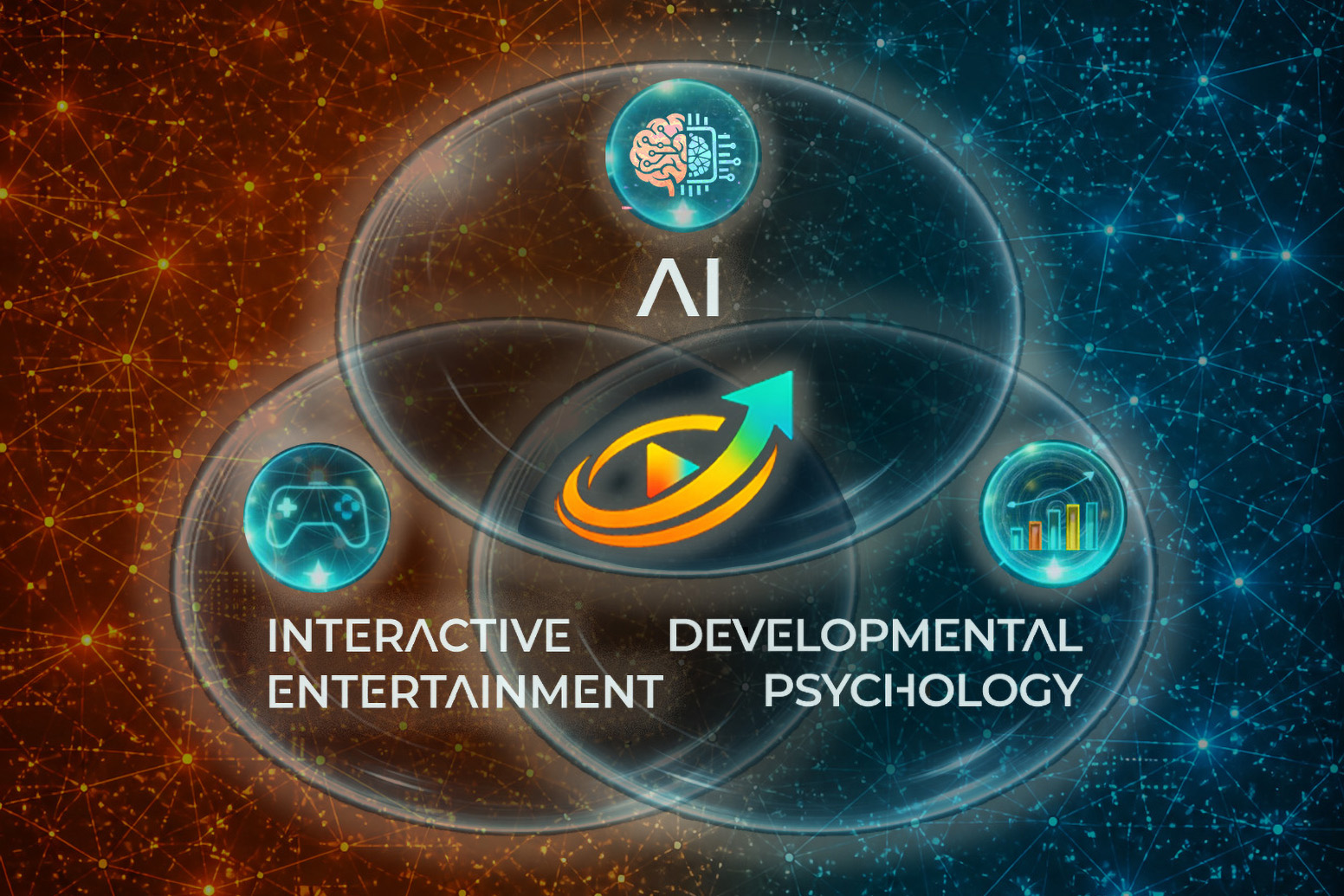
When developmental psychology - in its full richness, including the AQAL framework - is brought into the PPG convergence alongside interactive entertainment and AI, the picture becomes complete.
Interactive entertainment provides the vehicle, or
medium: engaging, immersive, freely chosen, capable of producing the states - especially flow - that are most conducive to growth.
Developmental psychology - and specifically, the five-element AQAL framework - provides the map: telling the engine where to go, in which dimension, for which player, toward what next edge of their development.
None of the three alone can produce what all three together make possible. The vehicle, the engine, and the map. Each essential. Each incomplete without the others.
In 2026, for the first time, all three are mature enough, and interconnected enough, to build something that has never existed before.

Site Architecture
Home



Gateway Pages







Research Trajectory · Deep Dive





Communication · Many Channels







contact
On the same wavelength?
If this research resonates with you - whether you work in AI, Interactive Entertainment, or Developmental Psychology, or simply want to connect as a kindred spirit - let's talk.


Developmental Psychology
© 2026 Press Play to Grow! All rights reserved.